
Call us now on 01356628560
Call us now on 01356628560
Featured in The Scotsman
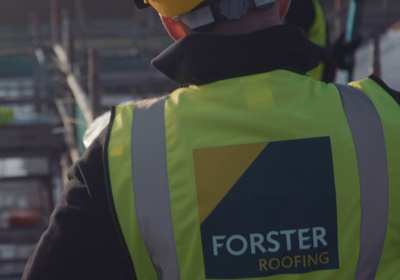
We need to think differently about skills, standards and solutions to build bigger and better capacity, says John Forster
As we enter 2026, the construction sector stands at the centre of the UK’s most urgent social and economic challenges. Whether it is resolving the housing crisis, accelerating the energy transition, or retrofitting homes and buildings for net zero, the message from policymakers, industry bodies and clients is the same: we need to scale up.
But the real question is not whether we need more capacity. It is whether we can build that capacity in a way that is genuinely sustainable – economically, operationally and environmentally. Scaling up alone will not deliver the outcomes Scotland needs. What we need is sustainable scale.
This distinction matters. Too often, “scale” is interpreted simply as “doing more”, whether that’s more houses, more installations, more retrofits. But unless that activity is delivered with the right skills, to the right standards and using the right solutions, we risk repeating the mistakes of the past – inefficiency, rework, skills shortages and a race to the bottom on cost. Sustainable scale is about building the capability to deliver more and deliver better.
Every major transition the UK faces, from decarbonising heat to expanding renewable energy infrastructure, depends on tradespeople. Electricians, joiners, plumbers, roofers: these are the professions that will physically deliver the future we are planning for.
Yet the industry has long talked about skills shortages as if they are inevitable. Our experience at Forster Group suggests otherwise. With a trades workforce whose average age is just 30, we have shown that construction can recruit, retain and develop the next generation when it invests in apprenticeships that are both affordable and effective. High completion rates are not a pipe dream; they are the result of a sustainable model that supports apprentices from entry to qualification and beyond.
If Scotland is serious about scaling up, then building a resilient skills pipeline is not optional. It is the starting point.
Sustainable scale also means raising standards. Like many across the construction sector, we’ve invested time and money in returning to fix what was not done correctly the first time. In a period where every hour of labour and every pound of investment counts, this is simply unsustainable. Building a resilient construction skills pipeline is essential for the future
Yet procurement practices often push in the opposite direction. The “flight to value” – where lowest price becomes the dominant factor – rarely leads to the best outcomes. It can compromise material quality, workmanship and long‑term performance. If we want scale that lasts, we must reward quality, not just cost.
At Forster Group, our own standards framework and plot‑pack approach are designed to ensure consistency, clarity and right‑first‑time delivery. But this is not just about one company’s methods. It is about a sector‑wide shift in mindset: scale without standards is not scale at all.
The third pillar of sustainable scale is innovation. We cannot meet 2026’s demands with 2016’s methods. Digital tools, automated processes and off‑site manufacturing are no longer emerging technologies, they are essential enablers of capacity.
Encouragingly, Innovate UK’s new funding line for pre‑commercialisation projects signals a recognition that innovation must be supported not just at the prototype stage, but at the point where it can be deployed at scale. For SMEs in construction and energy, this support is vital. Innovation only delivers impact when it reaches the market.
If there is one message the industry must embrace in 2026, it is this: we cannot scale by doing what we have always done. Sustainable scale requires us to think differently about skills, standards and solutions and to recognise that these are not separate challenges but interconnected parts of the same system.
Scotland has the opportunity to lead the way. But leadership will depend on our willingness to build capacity that is not only bigger, but better.
Featured in Project Scotland
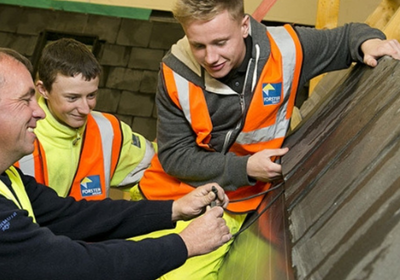
Scotland’s construction sector is facing mounting pressure from well documented skills shortages and an ageing workforce. Forster Group’s average age, which drops even further to 30 in its roofing division, contrasts with nationwide trends showing over a third of construction workers are aged 50 or over and set to retire by 2035.
Forster Group said that by investing in training, development, and clear career pathways through its Forster Skills Academy, the business is successfully bucking the trend.
“I’ve been with Forster Group for seven years now, and I’ve learned a lot in that time,’’ said Ryan O’Rourke (26), a qualified roofer with Forster Group who joined the Skills Academy in 2018. “I’ve had the chance to work on lots of different projects, and I have been given lots of opportunities to develop my skills and learn more about the industry. Forster Group has been a great place for me to start my career.”
Alongside a commitment to nurturing skills, Forster Group added that is focused on providing genuine career progression. Every apprentice receives training in solar PV installation, building skills that are designed to sustain Scotland’s net zero goals and deliver a future ready workforce. To date, the academy has supported over 100 new entrants through accredited programmes, achieving a 95% apprenticeship completion rate.
“We’ve built a team that’s young, skilled and ready to deliver,” said John Forster, chair and founder of Forster Group. “In a sector facing real challenges, our workforce is a signal of what’s possible when you invest in people and plan for the future.”
The company stated that its approach is paying dividends for housebuilders. With over 35 years of experience and a track record of delivering up to one in five roofs for new homes in Scotland, Forster Group said it offers certainty on ‘capacity, quality and reliability backed by a stable, highly skilled team’.
“When housebuilders choose Forster, they’re choosing a partner that’s ready to deliver,” added John Forster. “We provide the confidence that every roof will be completed on time and to the highest standards, with the next generation of talent leading the way.”
With a dedicated aftercare team Forster has been employed to resolve almost 300 remedial roofing projects installed by other contractors on new homes in the past three years alone.
The company is involved in the UKRI-funded AIMCH project, reinforcing its role in advancing on-site digital technologies and off-site automation.
“We’re proud to be part of the solution, not just to the skills gap, but to the housing and energy challenges Scotland faces,” said Lindsay Kemp, Skills Academy trainer and Scotland’s Apprentice Trainer of the Year 2022. “Our young team is building homes, building careers and building a better, healthier future for themselves and their families.”
Featured in Scottish Business News
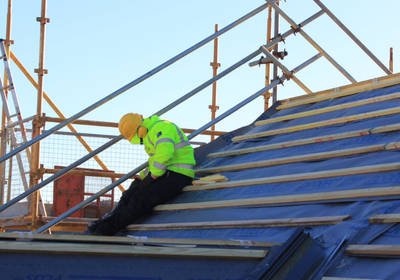
As Scotland’s construction sector faces mounting pressure from skills shortages and an ageing workforce, one company is proving that the future is already here and ready to build.
Forster Group, Scotland’s leading provider of integrated roofing, solar and battery storage solutions, has revealed that its workforce has an average age of 34, dropping further to 30 in its roofing division. The figure, drawn from internal research, contrasts sharply with nationwide trends showing over one-third of construction workers are aged 50 or over and set to retire by 2035.
By investing in training, development and clear career pathways through its Forster Skills Academy, established in 2015, Forster Group is successfully bucking the trend. Attracting, training and retaining young talent at a time when much of the sector is struggling to do so.
“I’ve been with Forster Group for seven years now, and I’ve learned a lot in that time,’’ said Ryan O’Rourke, 26, a qualified roofer with Forster Group who joined the Skills Academy in 2018.
“I’ve had the chance to work on lots of different projects, and I have been given lots of opportunities to develop my skills and learn more about the industry.’’ Ryan continued: “Forster Group has been a great place for me to start my career.’’
Alongside this long-term commitment to nurturing skills, is a focus on providing genuine career progression. Every Forster apprentice receives expert training in solar PV installation, building skills that sustain both Scotland’s net zero goals and a resilient, future ready workforce. To date, the Academy has supported over 100 new entrants through accredited programmes, achieving a 95% apprenticeship completion rate – well above the industry average.
“We’ve built a team that’s young, skilled and ready to deliver,” said John Forster, Chair and Founder of Forster Group. “In a sector facing real challenges, our workforce is a signal of what’s possible when you invest in people and plan for the future.”
The company’s approach is already paying dividends for housebuilders. With over 35 years of experience and a track record of delivering up to one in five roofs for new homes in Scotland, Forster Group offers certainty on capacity, quality and reliability backed by a stable, highly skilled team.
“When housebuilders choose Forster, they’re choosing a partner that’s ready to deliver,” added John Forster. “We provide the confidence that every roof will be completed on time and to the highest standards, with the next generation of talent leading the way.”
That confidence is underpinned by rigorous standards and a proactive service model that is often absent within the wider industry. With a dedicated aftercare team Forster has been employed to resolve almost 300 remedial roofing projects installed by other contractors on new homes in the past three years alone.
Tel: 01356628560
Email: enquiries@forstergroup.co.uk
Sectors | About Us | Privacy Policy
© 2024 Forster Group. All Rights Reserved.